
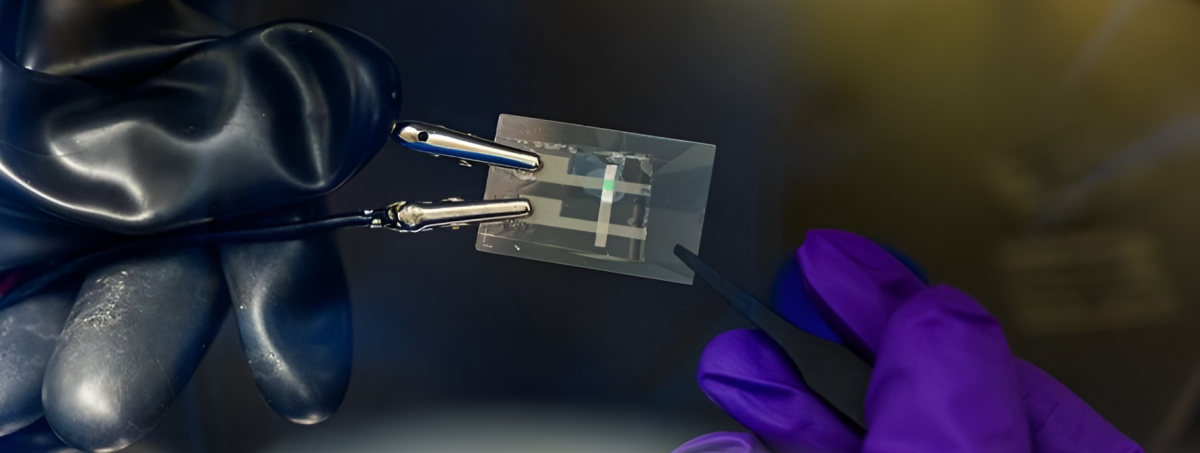
Researchers at the University of Chicago Pritzker School of Molecular Engineering have developed the next generation of stretchable organic light-emitting diode (OLED) screens, a breakthrough with implications for wearable electronics, medical devices, and humanoid robotics. Unlike conventional rigid OLEDs, these new screens can conform to 3D and irregular surfaces, enabling applications where integration with soft human-like materials is essential.
The innovation addresses two major challenges that previously restricted stretchable OLED performance: the cathode layer and the electron transport layer (ETL). Using an aluminium-gallium-indium gel, the team created a stretchable cathode that crackles rather than shatters when stretched. Liquid-metal embrittlement, usually considered a flaw, is harnessed to maintain conductivity and structural integrity under deformation. The gel flows into disconnections, preserving the device’s function over repeated stretching cycles.
Simultaneously, the team developed a novel polymer family for the ETL, balancing electron mobility with mechanical stretchability. Ring-shaped electron-deficient triazine-based groups provide conductivity, while linked alkyl chains allow elasticity. Adjusting the ratio of conductive rings to flexible chains enables fine-tuning of performance, ensuring electrons flow efficiently to the light-emitting layer without compromising stretchability.
Together, these innovations deliver fully stretchable OLED devices with performance approaching that of rigid screens, opening pathways for smart medical monitoring systems, wearable displays, and advanced robotics. The technology promises to integrate seamlessly with human-centric designs while maintaining high brightness, efficiency, and durability.
Associate Professor Sihong Wang and the team aim to advance these stretchable OLEDs into commercially viable products, marking a critical step toward flexible, intelligent electronics that combine performance with adaptability. This research, recently published in Nature Materials, represents a pivotal leap in both display technology and human-integrated electronic systems.
Read the full article to explore how UChicago’s stretchable OLED innovation could transform wearable tech, medical devices, and humanoid electronics.
(Photo Credits to University of Chicago)










.png)